
What is ICE and how has it changed during Trump's 2nd term?
Through the years, ICE agents have reportedly been involved in dozens of shooting incidents


The fatal shooting of Renee Nicole Good in Minneapolis on Wednesday was the second such incident in four months involving an Immigration and Customs Enforcement officer.
It's arguably also the biggest flashpoint yet as Donald Trump's second administration has called on ICE and other agencies to pursue an aggressive deportation strategy.
Here's a look at the history of ICE and some of the major developments and controversies surrounding the agency in the first year of Trump's second term.
ICE expansion over 20 years
ICE came into being after the Homeland Security Act was enacted in 2002, as the United States sought to grapple with the consequences of the attacks on Sept. 11, 2001. Individuals from four countries arrived in the U.S. beginning in 2000 and prepared and trained for the plane hijackings on 9/11.
Responsibilities and functions previously carried out by the Immigration and Naturalization Service (INS) workforce under the aegis of the Department of Labour were reconsidered, and ICE was established in 2003 under the Department of Homeland Security, focusing on the removal of unauthorized persons in the U.S. and stamping out cross-border trafficking of migrants.

The U.S. then and now has a significant number of unauthorized persons within its borders — the total is currently estimated at around 12 million by various immigration think-tanks. While president Ronald Reagan granted amnesty to a few million undocumented immigrants in 1986, that kind of measure has not occurred since.
Both Republican and Democratic presidential administrations have utilized ICE — Barack Obama was dubbed by some critics "the deporter-in-chief." But from the very first moments of launching his presidential campaign in 2015, Trump has focused on illegal immigration in an unprecedented way.
Speaking to CBC's Front Burner podcast in 2025, U.S. historian Adam Goodman said that over the years, "we've seen a real shift from the service side of the immigration bureaucracy to the enforcement side of immigration bureaucracy."

In his first administration, Trump sought through executive orders and his own pulpit to pressure some local and state law enforcement agencies who over the years began to limit their co-operation with ICE in some circumstances.
Since capping his political comeback last year, Trump and some of his closest advisers — including Stephen Miller — have expressed a desire for one million deportations a year.
The first-year Trump budget allocated more than $170 billion US over four years for border and interior enforcement, with $75 billion going to ICE for further arrests of immigrants, including the building of more detention facilities. In an analysis critical of the administration, the liberal Brennan Center for Justice said the ICE budget for 2025, at almost $29 billion, was nearly triple the amount of the previous year's budget.
ICE tactics and arrests
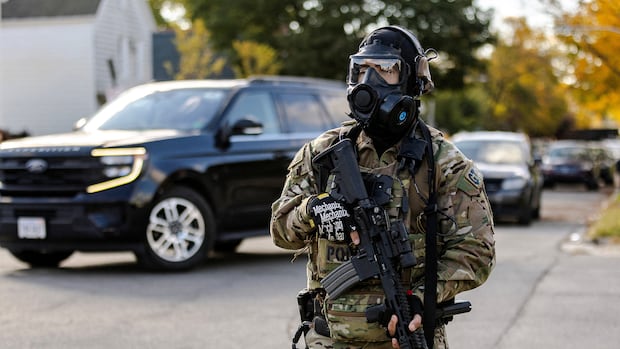
A lot of attention has been focused in the past year on ICE agents wearing masks and not identifying themselves.
Todd Lyons, who has been acting ICE director since last March and is still yet to be confirmed by the Senate, has said in multiple interviews it may sometimes occur to prevent the doxxing of officers.
"I'm not a proponent of the masks. However, if that's a tool [for] the men and women of ICE to keep themselves and their families safe, then I'll allow it," he told CBS's Face the Nation in July.
More seriously, ICE and Customs and Border Patrol (CBP) agents have in some incidents employed chemical agents and flash bangs. In a raid on a Chicago apartment building targeting gang members, agents rappelled from a Black Hawk helicopter.
Lyons has said ICE is focused on detaining the worst offenders for eventual deportation, but that anyone who is in the U.S. without authorization is subject to arrest, given the administration's priorities.
Mike Fox, a legal fellow with the Cato Institute, a libertarian think-tank in Washington, criticized that approach in September in an interview with CBC News.
"The [deportation] numbers are going to be a lot lower if you're actually focusing on the violent people that you should be focusing on," he said. "It's a lot easier to just stand outside a Home Depot and round people up."
Cato has been among a number of think-tanks and civil rights groups to point out that the statistics provided by the federal government have shown that significant numbers of people detained by ICE have not incurred a criminal record since entering the U.S.
Lyons has pointed out that data doesn't take into account criminal records in countries of origin.
Dozens of Canadian citizens are among those who have been detained. Given the administration's goals, it's an unsurprising development — in terms of visa overstays in the U.S., Canadians have perennially ranked high on the list.
The courts have not significantly hindered the way ICE goes about its business, with progressive organizations and some Democrats panning what they now call "Kavanaugh stops," since a controversial Supreme Court order in September.
"To be clear, apparent ethnicity alone cannot furnish reasonable suspicion; under this Court's case law regarding immigration stops, however, it can be a 'relevant factor' when considered with other salient factors," Justice Brett Kavanaugh wrote.
Shootings, but not indictments
Good's killing was the second fatal shooting by an ICE officer in four months. Good, a U.S. citizen, was not the target of any immigration enforcement and it's not clear what agents were doing in the Minneapolis neighbourhood.
ICE agents fatally shot Silverio Villegas González, a 38-year-old cook from Mexico, during a traffic stop in suburban Chicago on Sept. 12. The FBI and DHS have yet to release any information concerning previously announced inquiries into the shooting.

Three other people in the past eight months — two in California and one in Virginia — have died as a result of accidents while running from ICE raids.
Meanwhile, a gunman who opened fire on an ICE facility in Dallas last year killed a detainee instead of federal agents he was allegedly targeting. There were also non-fatal shooting incidents in Texas last summer near an immigration centre and a U.S. Border Patrol facility.
ICE-involved shootings before this year were rare but not unprecedented, according to The Trace, an outlet devoted to gun-related news. What is unheard of are prosecutions.
Obtaining court records from a lawsuit filed by a shooting victim, The Trace said they revealed that between 2015 and 2021, 59 shootings by ICE officers occurred across 26 U.S. states, leading to 23 fatalities.
"There's no evidence any ICE agent was indicted," The Trace reported.
According to a Reuters legal analysis, federal agents are generally immune from state prosecution if conducting their official duties. At the federal level, a prosecution would have to deal with the challenge of proving the officer didn't believe they were potentially facing the prospect of death or serious injury.
In terms of civil litigation, ICE agents, like police officers, are entitled to qualified immunity for on-the-job shootings, though some Democrats would like to change that.
It is also worth considering that Trump has made liberal use of his power to pardon or issue commutations to individuals accused or convicted of crimes. In his decade as a politician, Trump has, with the exception of the 2021 Capitol riot, supported aggressive law enforcement tactics.
While Trump's border czar Tom Homan said in a CBS interview on Wednesday that he wanted the investigation into Good's death to "play out" before making conclusive statements, the president himself and other officials have quickly sought to push a narrative that absolved the unidentified officer and questioned the victim's actions leading up to the shooting.
DHS Secretary Kristi Noem said on Thursday that the shooting was in response to "an act of domestic terrorism."
With files from the Associated Press and Reuters