
Rivalry and Respect
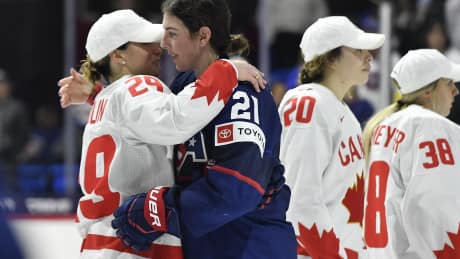
On a snowy January 2024 day, Marie-Philip Poulin and Hilary Knight skated toward the middle of the Verdun Auditorium ice.
It was a day of new beginnings in Montreal, which was hosting the first home opener for its new PWHL team.
The two players posed for the ceremonial puck drop photo alongside several legends in Montreal women’s hockey history: Poulin as captain of the Montreal team, and Knight, then captain of the Boston team.
After the puck was dropped, Poulin and Knight shared a quick hug. It was a moment of respect, and then on to the game, where they'd be opponents once again.
It was the first time Poulin and Knight met in a new league — one that both women launched, and that they hoped would last for long after they hung up their skates.

It was also the latest chapter in a rivalry that’s lasted the better part of two decades. One has been the face of women’s hockey in Canada, known for her ability to come up big when the stakes are highest. The other has been the face of women’s hockey in America, and a driving force behind building the PWHL.
No one has scored more golden goals at the Olympics than Poulin, who owns three gold medals.
No one has recorded more points, goals or assists than Knight at the world championship level, where she’s won 10 titles.
Knight has captured Olympic gold just once, in a shootout that devastated Poulin and her teammates in 2018
“She’s the face of the game,” Poulin said. “What she’s done for women’s hockey not only in the U.S. but around the world, it’s tremendous.”
For years, they drew attention to women’s hockey at a time when fewer people paid attention to their sport. Together, they have transformed the game.
“They’re generational players,” said Canadian general manager Gina Kingsbury, who also played with Poulin and against Knight on the national team.
“They’ve carried the weight of their country for many years now, and have been the face of women’s hockey in their respective countries. It’s beautiful to see what they’ve been able to accomplish. They’ve been part of a lot of different landscape shifting [in] the women’s game, and they’ve always been at the forefront of it all.”
Sixteen years after both made their Olympic debut in Vancouver, they’ll face off again in February in Milan, Italy.
While Poulin hasn’t given any indication that she’ll step away any time soon, Knight has said this will be her final Olympic Games. It’s one last chance for Poulin or Knight to come out on top in one of the best rivalries in all of sport.
It's also the last chance for fans to see an Olympic battle between two of the best to play the game, epic encounters that maybe we've taken for granted over all these years.
First-time Olympians
Knight doesn’t remember the first game she played against Poulin. It’s been too long, now, and there have been too many matchups to count. Nearly every big final in international women’s hockey over the past 15 years have featured both players.
“Two players coming up on dueling nations with this incredible rivalry, being able to step into the spotlight and really carry that rivalry forward and kind of go back and forth,” Knight said days after being named to her fifth U.S. Olympic team. “I have a tremendous amount of respect for her and what she's been able to do, and obviously she's an amazing player and it's just so much fun. And that's what you want, right? You want those high level, high octane competitive games, and I feel like the fans really feel a part of that rivalry. We sure do when we're on the ice."
Their first big battle came in 2010, when both players became Olympians in Vancouver.
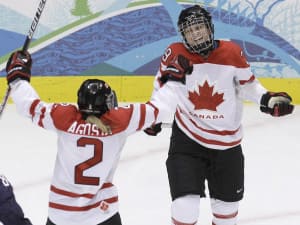
Poulin remembers waiting in a dressing room months earlier to find out whether she made the 2010 team. Players were called in to meet with Hockey Canada management from oldest to youngest, leaving a shy, 18-year-old Poulin to the end.
“I was able to call my parents right after,” Poulin said recently, as she promoted a new commercial from Cheerios that features her Olympic journey. “It was something very special.”
Knight had eight points in five games at her first Olympics in Vancouver. But it was Poulin who emerged with a gold medal around her neck.
The Canadian's first Olympic goal came in the first period of a pressure-packed final against the United States, in front of thousands of home fans. She scored another in that period, en route to shutting out the Americans, 2-0.
It was the world's first introduction to Poulin’s skill and her clutch gene. She would go on to score the golden goals at the 2014 and 2022 Olympics, too.
It’s why they call her Captain Clutch, a nickname Poulin isn’t too fond of hearing.
“Not sure how it came about,” Poulin said. “The first time I heard it, it didn't sound right and still to this day, it still doesn’t ring well in my ear. It’s a team sport. I’ve been pretty fortunate to live these moments, but I would not be here without my teammates.”
That sums up what will be Poulin’s lasting legacy, beyond the big goals and gold medals. She’s the ultimate player, with a hockey IQ that’s off the charts, smooth hands and a never-ending work ethic.
But she’s also the consummate teammate, who’s just as eager to set up a linemate and to encourage them off the ice.
Teammates in Montreal
It’s something that Knight saw firsthand when the two became teammates in Montreal with Les Canadiennes, a team that competed in the Canadian Women’s Hockey League (CWHL).
Back then, it was more of a rare occurrence for an American to move to Canada to play on a club team, when they couldn't make a living playing professional hockey.

The partnership lasted only one season. The CWHL folded in 2019, part of a chain of events that led to the creation of a players’ association that would build the vision for what became the PWHL.
But for that season, they helped create an all-star team, even if they never got to lift the CWHL’s Clarkson Cup.
“I just love how dedicated and diligent she is to the game,” Knight said. “She loves the game and you can obviously feel that through her play, but her preparation is outstanding.”
On the other side, Poulin marvelled at Knight’s skill when the American came to her home province.
“The way she sees the game, she’s quite smart,” Poulin said. “She has a high IQ. Her shot is something I’ve probably never seen before. She can snipe from anywhere possible. To just see that in practice or in game was something really awesome.”
Knight’s journey to Montreal came after a year that would play a big role in eventually changing the landscape of professional women's hockey.
In 2017, Knight was part of a group of players that successfully pushed for better conditions from USA Hockey.
They pointed out a long list of ways they were treated differently than the men's programs within USA Hockey. It ranged from support for training, to women’s hockey development at the grassroots level, all the way down to the hotels women stayed in and whether they received championship rings for their achievements.
The world championship was played on American ice in 2017, and the players used that as their leverage. Not only did they get a deal with USA Hockey, but they won that championship.
“To come together, to throw everything on the line, to stand up for something bigger than ourselves was the most empowering thing I've ever done,” Knight said.
Knight then followed it up with her first Olympic gold medal in 2018, the first time the Americans had won that title since 1998. Both Poulin and Knight scored in the gold-medal game before it went to a deciding shootout.

Had the American players not taken a stand in 2017, the PWHL as we know it might not have come to fruition.
When the CWHL folded in 2019, Knight was one of the leaders who created a players’ association. They vowed not to play in a league until they could create something sustainable. Her Montreal teammate, Poulin, joined the coalition.
A few years later, Knight was one of the players who negotiated a collective bargaining agreement with the owners of the PWHL ahead of the league's launch.
“I'd like to think that experience [in 2017] helped fuel our resilience to ideate and to create a CBA and to now play in what we call the PWHL,” Knight said. “I don't know if we would be where we are today on the professional standpoint without that equitable support battle. But obviously there are many, many pieces to that puzzle before 2017 that took place, and individuals that really carried the game and carried the sport on their shoulders.”
Pushing each other
Deep into two decades in the sport, Poulin and Knight remain among the best players in hockey. Both were nominated for the PWHL's MVP and top forward awards last season, after Knight led the league in points and Poulin scored the most goals. Poulin won both awards.
Points and goals aside, they pushed each other all season, just like they’ve been doing since they were teenagers.
“When you see a competitor that high, that plays at a high level, has high standards day in and day out, it makes you competitive too, that you want to be there and you want to beat them,” Poulin said. “That’s how we pushed the game. If she’s ready to go on game [day], I want to be ready to go. I want to push the pace even faster. Every year, we’ve done that. It’s been a privilege to do that.”

That is likely to continue for years to come. Poulin is signed with the Montreal Victoire through 2027-28. Knight has only one season remaining in her contract with the expansion Seattle Torrent, but she hopes to play “multiple” years with the Torrent.
“As long as I'm contributing to our group and having a lot of fun doing it, I would love to continue to keep playing,” Knight said.
The Americans go into the Olympics having won six straight games against the Canadians. That includes both games at last year's world championship, and all four of the Canada-U.S. Rivalry Series games this season.
There’s plenty of young talent rising on the American team. Many of them have shared pictures of younger versions of themselves with Knight. Some, including Caroline Harvey, Laila Edwards and Abbey Murphy, will be stars in the PWHL soon enough.
On the other side of the border, reigning PWHL rookie of the year Sarah Fillier is a big part of Canada's future. She grew up idolizing Poulin.
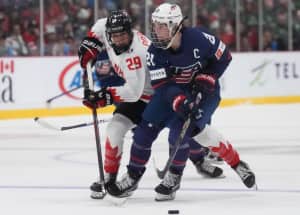
The women’s game is continuing to grow, becoming faster, stronger and more professional, largely thanks to the PWHL. But nothing will be able to replicate years of battles between two of the best to ever do it, in a world where best-on-best hockey wasn’t on TV every night.
It’s something that’s not lost on the next generation of stars. Fillier was only nine years old when she saw Poulin and Knight face off at the 2010 Olympics.
“It's what Canada-U.S. hockey is,” Fillier said. “Everyone knows Marie-Philip Poulin and everyone knows Hilary Knight, and I think that's been what's helped push the attention of women's hockey is that rivalry between [those] two.”