
Trump's U.K. visit looked like it would be dominated by trade. Immigration protests suggest otherwise
Immigration has re-emerged as incendiary issue in U.K., although overall numbers are falling


When King Charles, on the advice of the British government, extended an invitation to U.S. President Donald Trump for a second state visit to the U.K., it appeared trade and economic relations would dominate discussions.
But when Air Force One touches down at Stansted Airport on Tuesday night, Trump will find himself landing in a country where political priorities have flipped.
While Britain's anemic economic growth and the uncertainty created by Trump's tariffs remain serious concerns, what's perhaps more immediately worrying for his host, Prime Minister Keir Starmer, is the return of immigration to the top of the country's political agenda.
The last time that happened, in 2016, passions were so inflamed that Britons embraced Brexit and voted to bolt from the European Union.
This time, it's not a flood of newcomers from less-well-off parts of Europe that has riled people up — it's the unrelenting arrival of small boats carrying asylum seekers from the poorest Asian and African nations, such as Afghanistan and Sudan.

As many as 30,000 people have made the often deadly — and illegal — journey across the English Channel this year, confounding most efforts by the French and British governments to stop them.
Closely linked to the small boats issue is the cost of housing the asylum seekers in government-paid hotels — more than two billion pounds this year alone — along with widespread complaints, valid or not, that it has fuelled violent crime and social disorder in neighbouring communities.
Britain is also coming off of an unprecedented surge in legal immigration, driven by students and workers from places such as Nigeria and India, igniting concerns that will be familiar to Canadians, including putting too much pressure on the housing market and public services and being responsible for too much social change too fast.
Fuelling Farage
The upstart Reform UK — modelled in part on its Canadian namesake, founded by Preston Manning — has been the main political beneficiary of the widespread discontent, propelling it to unseen heights in British politics.
The far-right party led by former Brexiteer-in-chief Nigel Farage has only five seats in Britain's Parliament (one of which came this week with the defection of a Conservative MP), but multiple opinion polls now suggest if an election were held today, Farage would become the country's next prime minister.
In fact, the former Conservative governments of Boris Johnson and Rishi Sunak tried to use an immigration surge to jump-start the U.K. economy after the COVID-19 pandemic, but it's Starmer and his Labour front bench who are paying a steep political price for it.

In one recent opinion poll, 70 per cent of Britons said they felt immigration — including by people who arrived legally — is too high.
Over the weekend, London witnessed one of the largest protests in years, with immigration at the forefront of concerns.
More than 150,000 people marched across the city's bridges waving Union Jacks and carrying flags featuring the red and white Saint George's Cross, calling for deportations and a halt to immigration.
"Illegal women are more protected than I am," claimed Dominique Boucher, who came to the event wearing a self-made hat emblazoned with "MEGA," or Make England Great Again, a play on Trump's familiar MAGA slogan.
"I've got two children, I'm scared about going to town because it feels like there's a lot of attacking going on and there's sexual assaults, rape, and everything seems to be kind of uncontrollable at the moment," Boucher told CBC News.
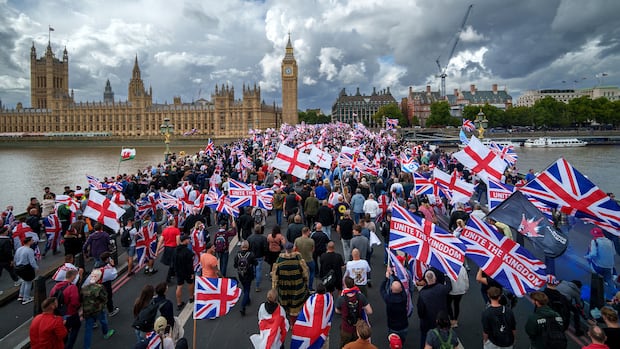
The extent to which immigrants — legal or not — are responsible for crime in the U.K. is fiercely challenged by refugee advocates and academic experts. Nonetheless, the notion was a central theme for many of those on the streets on Saturday.
None other than Elon Musk, a well-known enthusiast of Europe's far-right parties and Trump's former chief public service hatchet man, amplified that message in an appearance by video link at the event.
"Violence is coming. You either fight back or you die," said Musk, referring to what he termed "massive, uncontrolled migration" and calling for Britain's current government to be dissolved.
Farage has repeatedly likened the migrant boat crossings to an "invasion" and said Britain should withdraw from any legal treaties or international conventions that require giving people asylum hearings, even though it's part of international law.

Reform UK's position is that everyone who arrives in a small boat, regardless of their circumstances or background, should be automatically deported.
Migration declining
The reality is that immigration has fallen rather dramatically in the last couple of years. And the arrival of migrants in small boats across the channel represents a relatively small portion of the people coming to the U.K.
"This idea that we're not in control of our borders has been hijacked by a certain section of policymakers and particularly politicians," said Jenny Phillimore, professor of migration and superdiversity at the University of Birmingham. "All of our social and economic problems are blamed by some people on migrants in this country."
According to government figures, net migration reached a peak in 2023, when the U.K. gained 906,000 people. For much of the previous 20 years, yearly net gains were far lower — in the 200,000-300,000 range.
Since the 2023 high point, migration has dropped steeply, with a net gain of 431,000 in 2024.

Far and away the largest group of newcomers continues to be students — not refugee claimants — granted visas to study at U.K. schools and universities. Health-care workers make up the next largest group.
By comparison, people arriving illegally across the Channel represent only a single-digit percentage of the total.
Crossings reached a peak in 2022, when 45,000 people came. So far in 2025, the number of arrivals stands at 30,000.
"The boats are tiny, tiny parts of [the migration issue]," said Phillimore. "But they are the most visible."
'One in, one out'
New rules brought in by Starmer's government are aimed at reducing legal immigration even more.
It has struck a new agreement with France, known as the "one in, one out rule", where for every migrant deported back to France, Britain will allow a pre-screened claimant to enter the country legally.
The government has also tightened eligibility rules for remaining in Britain. All immigrants will now have to meet higher standards of English proficiency. Qualifications for people coming as skilled workers have been raised and the government is restricting how long people who come on student visas can stay after their education program ends.
It's also extending the timeframe to qualify for permanent residency in Britain.
But the issue of how to stop the Channel boats continues to perplex British policy-makers, and Phillimore says housing migrants en masse in hotels was always a terrible idea.
"If you put 300 youngish people, many of whom have experienced trauma, in one place, sharing rooms with complete strangers, nothing to do all day, there will be problems whether they are British citizens or whoever they are," she said.

Starmer's government has promised to end the practice of hotel stays for asylum seekers within four years, dispersing people to flats, private apartments or converted military barracks instead.
Still, the broader political backlash is pushing Labour to act even faster.
Gauging the Trump effect
Just how influential Donald Trump has been on Britain's anti-immigrant movement is harder to discern.
While his declaration of an emergency at the U.S.-Mexico border and cutting off of most refugee claims dovetail with Reform UK's policies, the U.S. president remains a very unpopular figure in Britain.
"I'm not interested in Americans. I'm more interested in my own country than what's happening over there," one man wrapped in a Union Jack told the CBC on Saturday.
Along with the protesters In London's streets this past weekend, there was a much smaller group of counter-protesters, which included Cathy Urquhart. She was critical of the Starmer government for not pushing back harder on what she says are false narratives about immigrants.
"I'm incredibly concerned about the creeping rise of far-right activity on our streets, outside asylum seekers' hotels, making people of colour feel unsafe across the country," she said.
"It's just terrifying to see, and ... our politicians are letting this happen."
ABOUT THE AUTHOR
